
Bellows, sleeves and expansion joints are the connecting elements between rigid system components that thermally expand, vibrate or shift against one another. If these relative movements are not compensated, mechanical stresses arise that widen pipe connections, damage flanges, overload bearings and ultimately lead to system failure. The design of an expansion joint is therefore not an accessory problem, but a core design task.
As a manufacturer of flexible expansion-joint systems, MST-Flexduct manufactures bellows, sleeves and expansion joints for mechanical engineering, rail, engine technology and plant engineering. The products are designed for the actual movement profiles: axial travel, lateral offset, torsion angle, temperature range, operating pressure and excitation frequency are jointly incorporated into the material selection, convolution geometry and layer structure. The result is components that work reliably and permanently under real system conditions.
Bellows & expansion joints for dynamic systems
Line systems in industrial applications are constantly exposed to changing forces: thermal expansion, vibrations, torsion, pressure impulses and installation-space-related movements. Bellows and expansion joints absorb these movements in a targeted manner without impairing tightness, pressure resistance or dimensional stability.
The design takes into account movement direction, amplitude, temperature range, media load and mechanical stresses. Only a joint consideration of all these parameters results in an expansion joint that functions reliably and permanently under real operating conditions and protects the service life of adjacent assemblies.

Talk to our experts
Together we develop the right industrial hose for your application. We advise you on a technically sound and project-oriented basis.
Axial, radial & torsional movements
Industrial applications generate different types of relative movement, each requiring specific expansion-joint geometries:
- Axial movements: length changes due to thermal expansion or pressure stroke. Typical design values: ±5 to ±50 mm axial travel depending on free line length and temperature range
- Radial movements: lateral displacements between units due to tolerances, installation deflections or dynamic shifts under operating load
- Torsional movements: twisting due to torques and operating dynamics, particularly relevant at shaft connections and coupling points
- Combined movements: superimposition of several types of movement, e.g. axial plus lateral, require multi-axis-designed expansion joints
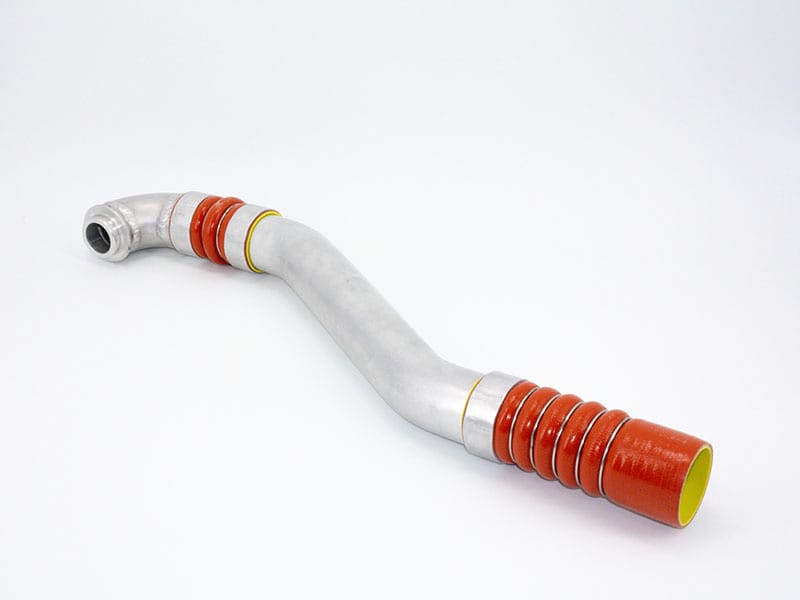
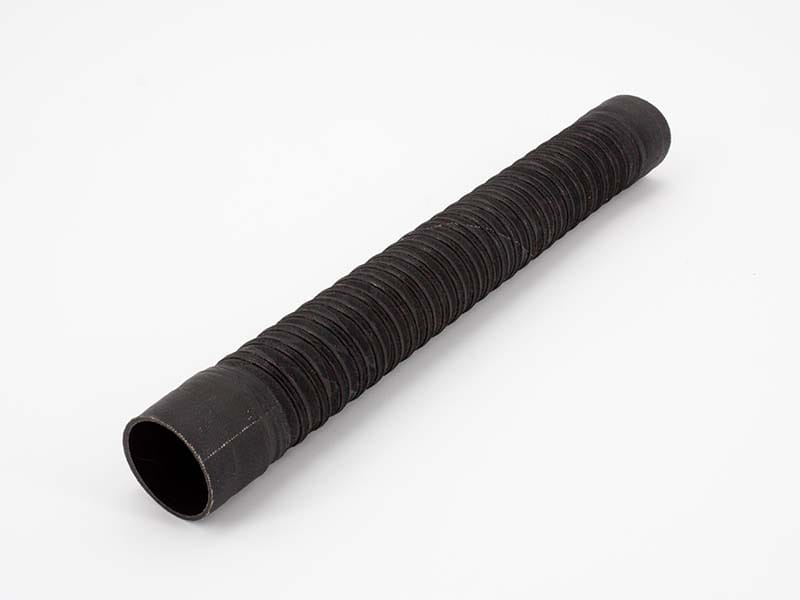
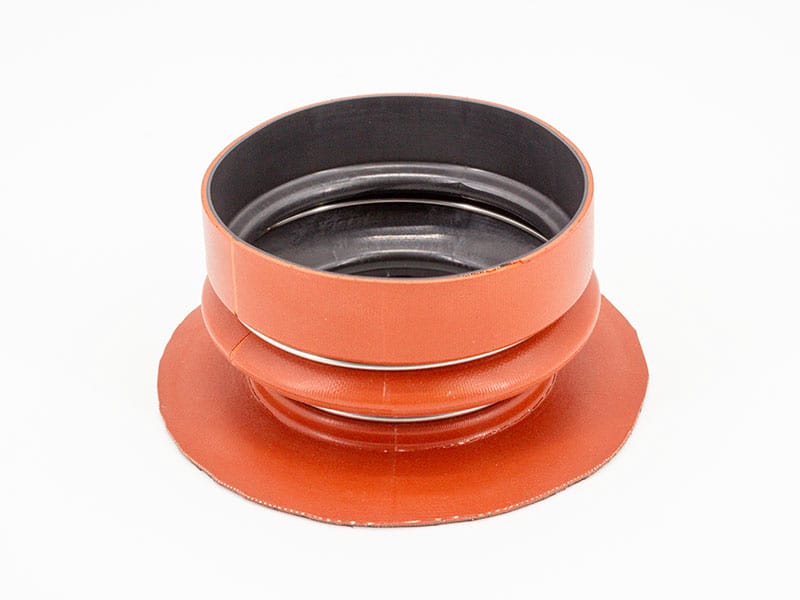
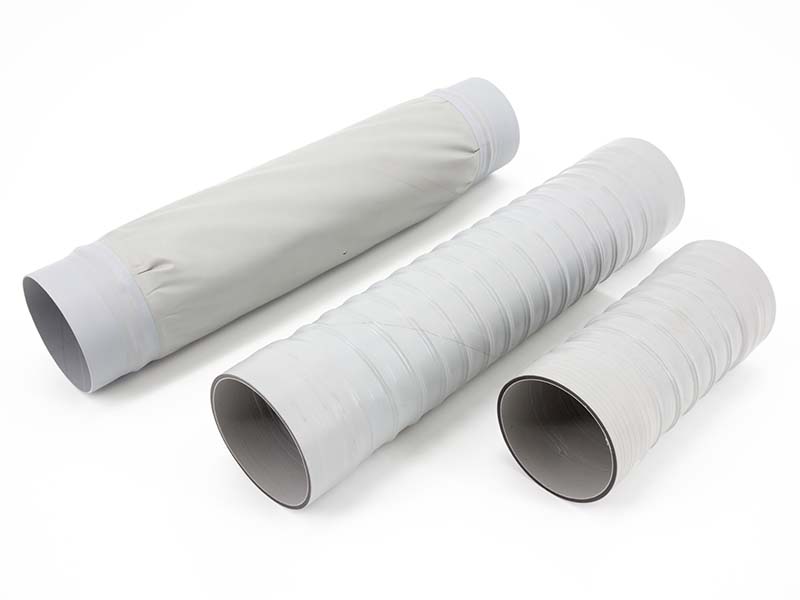
MST-Flexduct develops expansion joints tailored to one or more of these types of movement. Geometry, wall thickness, fabric selection and layer structure are designed exactly for the load profile in order to reliably prevent cracks, leaks or material fatigue.
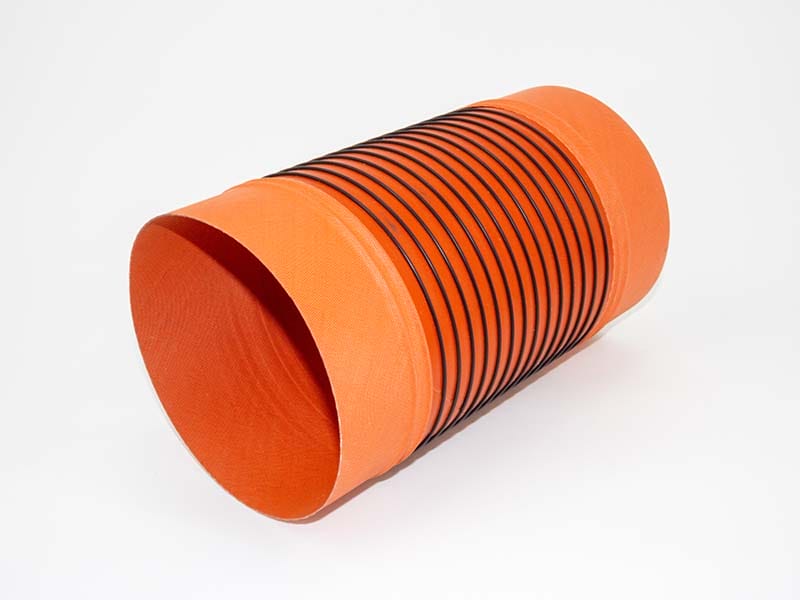
Materials & layer structure
For bellows and expansion joints, robust, temperature- and media-resistant composite systems are used. The material selection is based on the actual operating profile:
VMQ (silicone): continuous temperature resistance up to +200 °C (short-term up to +250 °C), very good resistance to temperature changes, used for hot air, EGR and thermally highly loaded expansion joints
VMQ/glass-fabric hybrids: combination of silicone structural flexibility and glass-fabric strength for applications up to +400 °C, suitable for turbocharger outlets and industrial exhaust systems
EPDM: resistant to water, steam and ozone up to +150 °C, used in cooling-system expansion joints and climate-line sleeves
CR (chloroprene): good oil and fuel resistance at medium temperatures, for expansion joints in the engine-adjacent area with oil mist
Special elastomer compounds: for applications with aggressive media or combined requirements of media resistance and low-temperature flexibility
Multi-layer elastomer-textile structures combine high flexibility with dimensional stability, pressure and vacuum resistance as well as a long service life in vibrating systems at the same time.
Applications in mechanical engineering, rail & engine technology
Expansion joints and bellows are indispensable wherever line systems must remain in motion.
Typical fields of use are:
Thermal expansion in hot-air and exhaust lines on turbochargers, CHP units and industrial furnaces
Vibration decoupling between combustion engines and vehicle structure in automotive and commercial vehicles
Flexible transitions in HVAC and air-supply systems of rail vehicles to EN 45545-2
Engine-adjacent and unit-adjacent line systems in EGR, charge air and exhaust-gas after-treatment
Transitions between rigid and flexible components at bogie transitions in rail vehicles
Axial expansion joints in industrial pipe systems to AGFW recommendation and DIN EN 14917
In all cases, the correctly designed expansion joint makes a decisive contribution to protecting adjacent components from mechanical overload and avoiding unplanned system failures.
Series production with tolerance reliability
For OEM, rail and mechanical-engineering customers, stable series production is decisive. MST-Flexduct supplies bellows and expansion joints with high repeatability, clearly defined tolerances and documented test processes.
Every component corresponds to the geometry, movement absorption and material quality of the approved sample. Deviations in the convolution geometry directly change the spring behaviour and the axial stroke. Through defined manufacturing tools and several production sites, a reliable supply is ensured over the entire life cycle.
Quality & function tests
Depending on the technical requirement, the following tests are carried out:
- Function tests for axial, radial and torsional movements with defined travel limitations
- Pressure and vacuum tests at operating temperature for combined pressure/movement loads
- Temperature-change and ageing tests to DIN 53508 / ISO 188
- Vibration tests for service-life qualification under dynamic continuous load
- Dimensional and geometry checks for convolution count, wall thickness and outer geometry
- Media-related load tests for oil, fuel, exhaust-gas condensate and cooling media
- Documented series approvals and inspection protocols to IATF 16949, IRIS or customer-specific specifications
These tests ensure the permanent functionality of the components under real operating conditions — an essential factor for safety-critical systems in engine technology and rail technology.
Why MST-Flexduct?
Expansion joints and bellows must absorb movements without losing tightness, pressure resistance or functional reliability. An incorrectly designed expansion joint that is too stiff, too soft or wrongly dimensioned damages the adjacent components or fails prematurely itself.
MST-Flexduct combines materials expertise, design experience and series-capable manufacturing to supply components that work reliably and permanently under real system conditions. Axial travel, lateral flexibility, pressure resistance and temperature resistance are not considered individually, but solved as a combined design problem.
Our manufacturing enables:
- Specialized solutions for axial, radial and torsional movements with defined characteristic values
- Multi-layer layer structures for combined temperature, pressure and movement loads
- Durable, vibration-resistant components with vibration qualification to DO-160G or IRIS
- Reproducible OEM series quality with documented movement testing per batch
- High vertical integration and stable supply chains for long-term programmes
- Precisely designed components for demanding systems in engine technology, rail and mechanical engineering
MST Flexduct
Specialist for Bellows, Sleeves & Expansion Joints for Movement Compensation
Do you need bellows, sleeves or expansion joints for movement-intensive or safety-critical applications?
MST-Flexduct supports you with design, prototype phase and series production. Send us your specification stating type of movement, axial travel, operating temperature and media profile.
Specialist for bellows and expansion joints in engine technology, rail and mechanical engineering. Inspection reports and series approvals to IATF 16949, IRIS and customer-specific standards.