
Flexible line systems in aircraft and rail vehicles are subject to mandatory fire-protection requirements. FAR 25.853 and CS-25 regulate the flammability and smoke behaviour of cabin materials in commercial aircraft, EN 45545-2 defines the fire-protection classes for rail vehicles according to hazard level, and ABD 00031 specifies the Airbus-internal material requirements for approval processes. Hoses and line systems used in these areas must not only pass the respective standard but also demonstrate compliance with complete inspection reports from accredited institutes.
As an experienced manufacturer of standard-compliant hose systems, MST-Flexduct develops flexible line systems that meet these standards and can be reliably used in OEM series environments. Material selection, layer structure and evidence documentation are developed together with the customers’ quality and approval departments and are tailored to the specific installation locations and hazard levels.
Requirements for material & flammability behaviour
Standard-compliant hose systems for aviation and rail have to withstand considerably higher requirements than classic industrial components. Decisive here are not only individual standards, but the interplay of several test categories:
- Flame retardancy: self-extinguishing inner and outer layers, defined burn rates in mm/min, maximum burn duration after flame removal
- Smoke development: specific optical density Ds,max below 200 (flaming) and below 200 (non-flaming) to ASTM E662
- Toxicity: limit values for HCN, HF, HCl, CO, SO2 and NOx to BSS 7239 or NF X 70-100
- Heat release: maximum heat release rate (peak HRR) and integrated heat release to OSU calorimeter (FAR 25.853 App. F Part IV)
- Mechanical resistance: dimensional stability and layer integration under continuous thermal and mechanical load
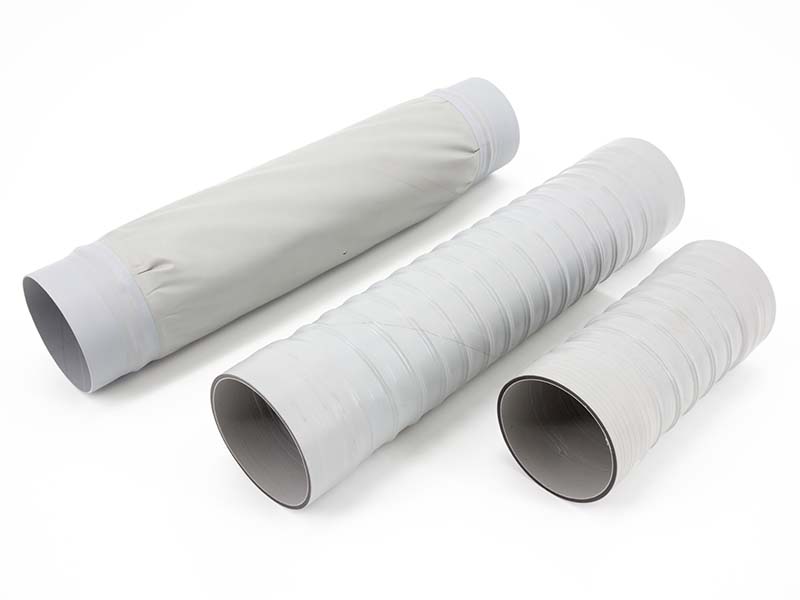
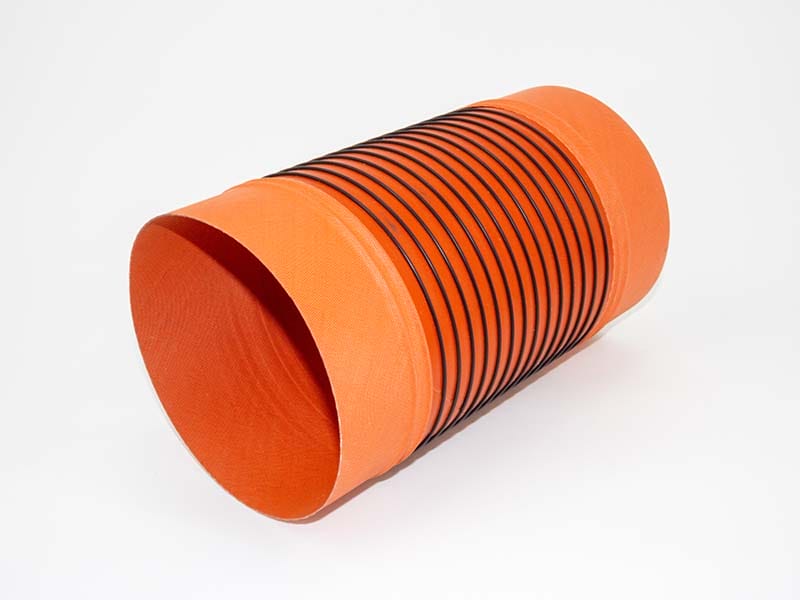
For this, MST-Flexduct uses specially developed elastomer-textile composite systems. Through the combination of technical fabrics, flame-retardant coatings and defined layer structures, line systems are created that are both highly thermally resilient and fully safety-compliant.
Talk to our experts
Together we develop the right industrial hose for your application. We advise you on a technically sound and project-oriented basis.
Standards at a glance
Compliance with international standards is a central topic in the aviation and rail industry. Each standard sets different requirements, which MST-Flexduct knows in detail and takes into account in product development:
Regulates the fire behaviour of cabin materials in transport and regional aircraft. Test paths to Appendix F:
- Part I: 60-second vertical test and 60-second horizontal test for thick-walled materials (limit value: max. 152 mm/min burn rate, max. 15 s afterburn duration)
- Part II: 12-second flame test for thin materials under 2 mm (limit value: max. 152 mm burn length)
- Part III: OSU calorimeter test for heat release rate (max. 65 kW/m2 peak HRR, max. 65 kW·min/m2 in 2 min)
- Part IV: Smoke-gas toxicity test according to the Federal Aviation Authority (FAA) on request
Fire-protection requirements for materials and components in rail vehicles. Hazard levels and associated requirement sets:
- HL1: Vehicles on routes with tunnels up to 1 km – requirement sets R1, R2, R3, R5, R6, R7 etc. depending on the installation location
- HL2: Vehicles on routes with tunnels over 1 km – higher limit values for Ds,max and CIT
- HL3: Metro vehicles and high-speed trains in long tunnel systems – strictest requirements
Test parameters: Ds,max (smoke density), MAHRE (average heat release rate), CIT value (toxic smoke-gas concentration to NF X 70-100)
Airbus-internal set of standards for materials in cabin and technical areas. Requirements include:
- Flame resistance: burn rate, afterglow duration and after-glow duration to defined test conditions
- Emission behaviour: smoke density Ds,max and toxic gas concentrations to AIMS test methods
- Material integrity under heat exposure: testing for dripping behaviour and structural decay
Special test conditions for cabin and technical areas according to installation class
MST-Flexduct develops hose systems that are tested, documented and demonstrably suitable for these specifications.
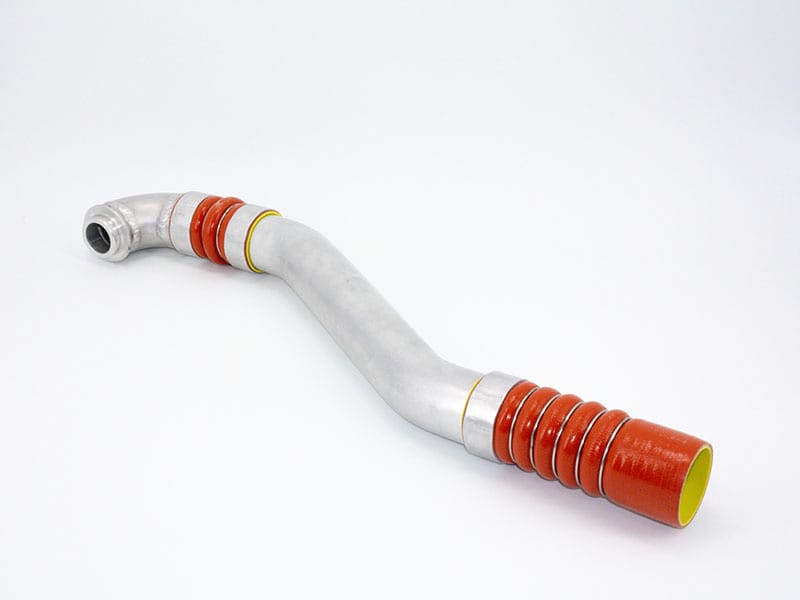
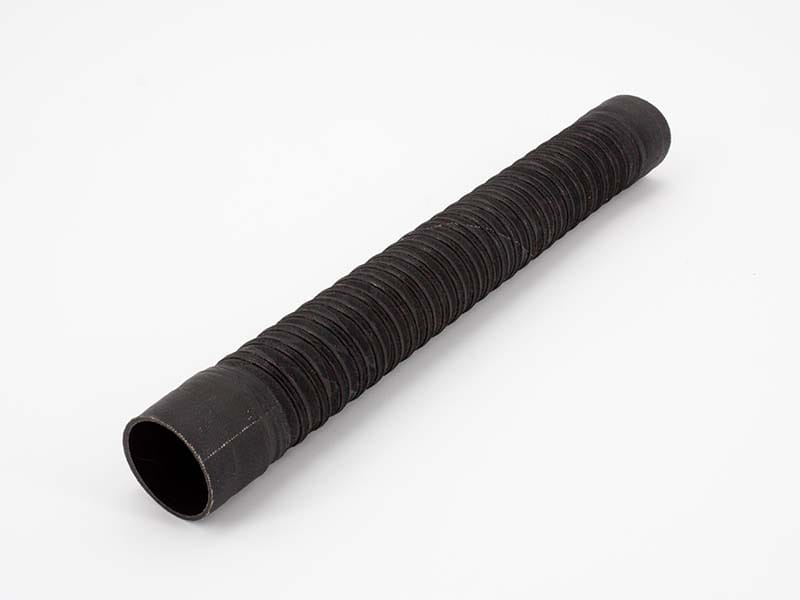
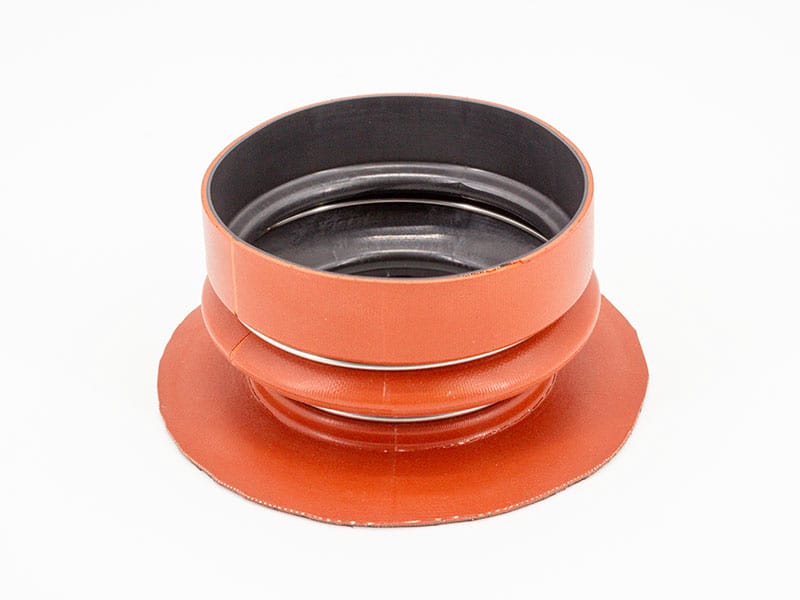
Applications in rail & aviation
Standard-compliant hose systems are used wherever fire protection and material behaviour under extreme conditions have the highest priority.
Aviation:
- Air-conditioning systems (ECS) with hot-air routing from bleed-air branches
- Drainage lines for condensation-water discharge in the lower fuselage area
- Cabin air routing and blow-in ducts in the passenger compartment
- Technical supply lines in avionics and control-unit areas
- Galley and sanitary-area exhaust air with direct cabin reference
Rail industry:
- HVAC systems for passenger areas in regional, long-distance and metro vehicles
- Air routing in the passenger compartment to EN 45545-2 hazard level HL1 to HL3
- Technical supply ducts in traction and drive areas
- Flexible transitions between rigid line segments on bogies and car couplings
Regardless of the specific application, these systems must function safely at all times: in tight installation spaces, changing temperatures, different air pressures and long maintenance intervals. Standard-compliant materials are therefore not just a regulatory standard, but an essential component of operational safety.
Documentation & traceability
In the aviation and rail industry in particular, traceability plays a central role. Every component must be clearly traceable, from the raw-material batch to the final delivery. This is a prerequisite for type tests, DOA processes to EASA Part-21 and ongoing surveillance audits.
MST-Flexduct ensures that:
- every product is provided with a unique serial number and batch identification
- raw-material batches are documented with material certificates to EN 10204 Type 3.1
- inspection reports from accredited institutes can be clearly assigned to the respective serial number
- internal quality processes are documented in an auditable and revision-proof manner to AS9100 or IRIS/ISO TS 22163
- OEM-compliant documentation packages for type approvals, type certificates and authority audits are provided
Test processes & quality evidence
Regulatory evidence is indispensable for OEMs, approval authorities and operators. MST-Flexduct subjects all standard-relevant products to defined test processes, which vary depending on the applicable standard.
These include:
Horizontal and vertical flammability tests to FAR 25.853 Appendix F Part I and II
OSU calorimetry test for heat release rate to FAR 25.853 Appendix F Part IV
Smoke-density measurement (NBS method) to ASTM E662 with evaluation in flaming and non-flaming mode
Toxic gas analysis to BSS 7239 (aviation) and NF X 70-100 (rail)
Fire-behaviour tests to EN 45545-2 for relevant requirement sets R1 to R25
ABD 00031-compliant material tests for Airbus certification processes
Temperature-change and ageing tests to DIN 53508 / ISO 188
Dimensional and shape tests under temperature load
The results are documented in a traceable manner and provided on request as complete approval documentation packages. This enables smooth transfer to internal and external audits as well as to approval authorities.
Why MST-Flexduct?
Standard-compliant line systems are safety-critical elements. A faulty material or insufficient evidence can not only lead to rejection of the component, but also cause approval delays, production stoppages and regulatory consequences. In the aviation and rail environment, these are direct project risks.
MST-Flexduct combines deep materials knowledge with a sound understanding of the relevant sets of standards and strictly documented test and approval processes. This means: hose materials are not only checked for standard conformity at the end, but designed from the start of development for the applicable test paths. With MST-Flexduct, OEMs and operators get a partner who not only ensures standard conformity but actively integrates it into development and series production.
Your advantages at a glance
- Tested hose systems to FAR 25.853 (incl. Appendix F), EN 45545-2 (HL1 to HL3) and ABD 00031
- Complete smoke-density and toxicity evidence to ASTM E662 and BSS 7239
- Standard-compliant materials for all hazard levels and requirement sets to EN 45545-2
- Inspection reports from accredited institutes as a mandatory part of the delivery documentation
- Complete traceability with material certificates to EN 10204 and batch-related test assignment
- OEM-compliant documentation packages for type tests, DOA processes and authority audits
- Technical advice on standard selection, hazard-level assignment and test-path definition
MST Flexduct
Specialist for Hose Systems to FAR 25.853, EN 45545-X & ABD 00031.
Do you need hose systems that are standard-compliant tested, documented and approved for safety-critical areas in aviation or rail?
MST-Flexduct supports you from material selection and hazard-level assignment through to complete series approval with audit-capable documentation.
Experienced manufacturer of standard-compliant line systems for aviation and rail. Inspection reports from accredited institutes. Documentation packages for EASA-, FAA- and German Federal Railway Authority-compliant certification processes available on request.