
MST Flexduct
Molded Hose Manufacturer
for Complex Geometries & Tight Installation Spaces
Request now
As an experienced molded hose manufacturer, MST-Flexduct develops and produces shaped line systems, elbows, bends and special geometries for applications in which standard products are not sufficient. Our molded hoses are used wherever installation space is limited, tight radii are required or flow-optimized solutions decisively improve functionality.
For automotive, aviation, rail, mechanical engineering and plant engineering, we manufacture customer-specific hose geometries that are tailored exactly to the design, thermal and mechanical requirements. Every geometry is created on the basis of your CAD data (STEP/IGES) and is delivered in reproducible OEM series quality in accordance with IATF 16949 and AS9100.
Molded hoses for individual installation-space requirements
In modern systems, installation space is becoming a critical factor. Lines must be able to be routed past body structures, engine components, units or air-routing systems without impairing function or safety.
A straight hose is rarely usable in such environments. Designers need solutions that are adapted exactly to the available installation space. MST-Flexduct develops molded hoses on the basis of the technical parameters of your application, including defined angles, radii, wall thicknesses and transitions. Bend radii with D/d < 1.5 can be realized in a multi-layer system.
Every molded geometry is designed so that it withstands both mechanical loads and thermal influences while functioning optimally in terms of flow.
Talk to our experts
Together we develop the right industrial hose for your application. We advise you on a technically sound and project-oriented basis.
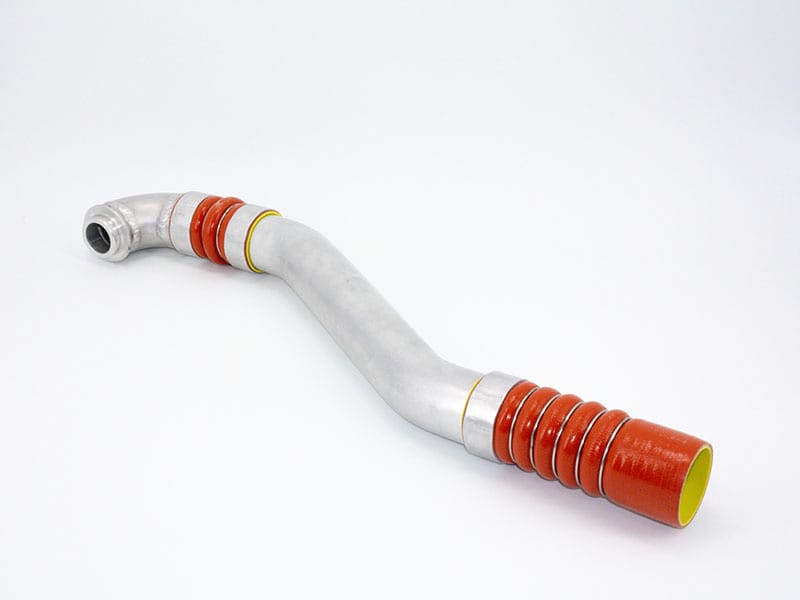
Elbows, bends & complex geometries
MST-Flexduct molded hoses are often created where classic pipe systems reach their limits.
In contrast to rigid designs, flexible molded hoses enable flow-cleanly and at the same time installation-space-optimized routing. This reduces pressure losses and allows heat sources or moving components to be safely bypassed.
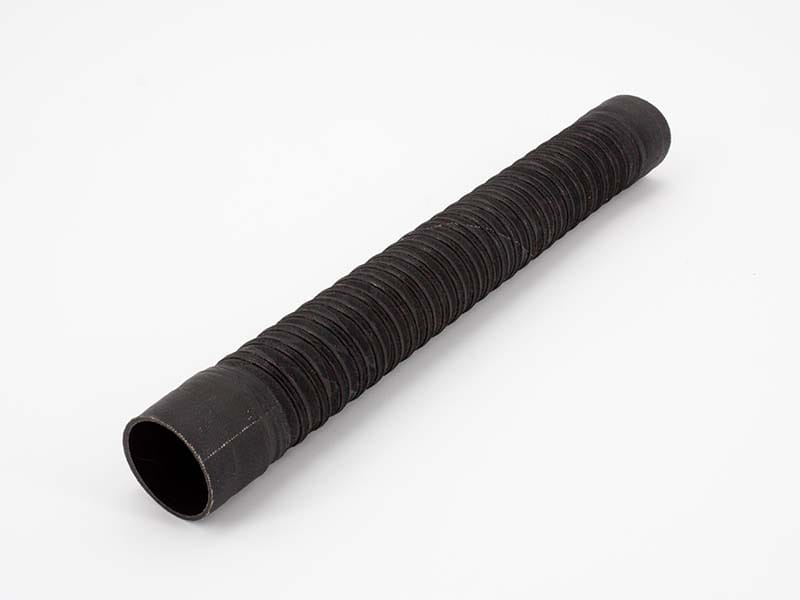
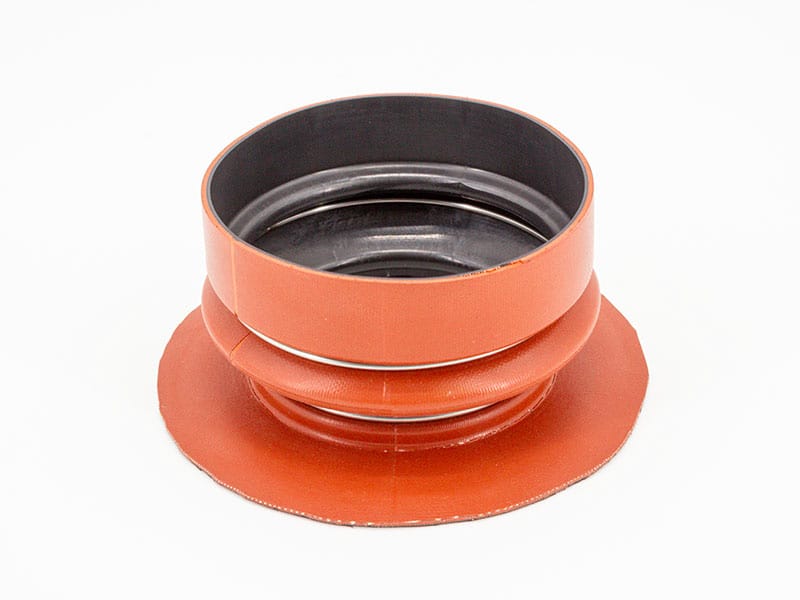
For components that additionally have to absorb oscillations or vibrations, we combine molded hoses where necessary with integrated bellows sections or reinforcement rings.
With shaped hoses, we realize:
- Elbows with defined angle progressions (15° to 180°)
- Bends for tight radii (D/d ratio < 1.5)
- Branches, T- and Y-elements
- Multi-stage geometries with changing diameters
- Complex installation situations based on STEP/IGES data
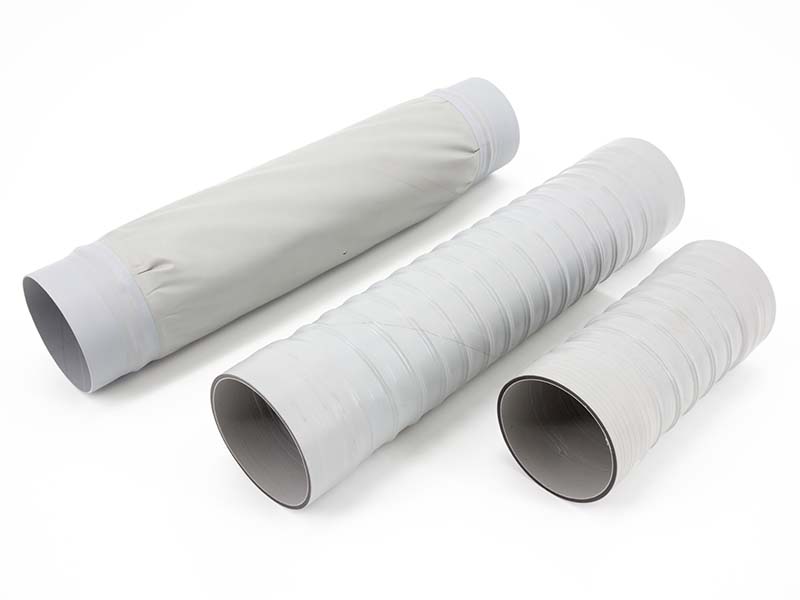
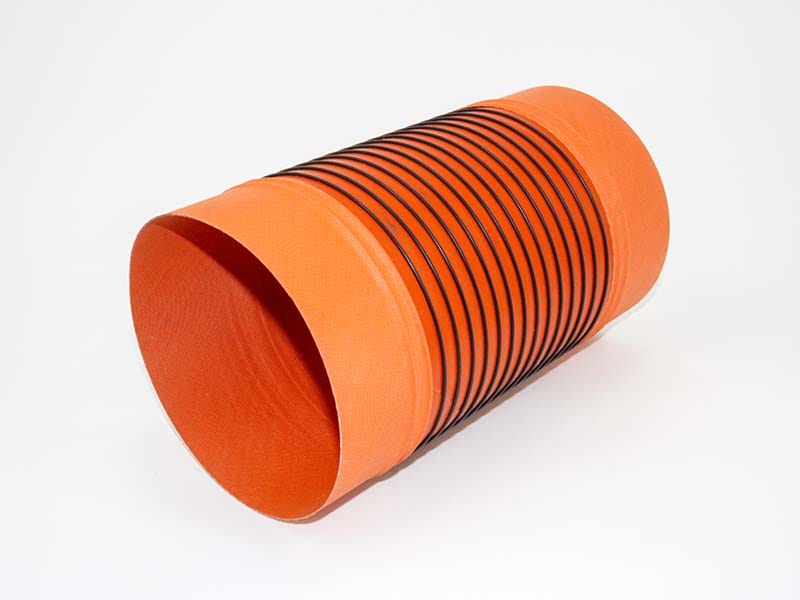
Materials & fabric reinforcements
The choice of materials is a central element of the design. Depending on the field of application, elastomers such as silicone (VMQ, up to +200 °C), neoprene (CR, media-resistant), EPDM (up to +150 °C, UV- and ozone-resistant), NBR (for fuel and oil contact) or FPM/Viton (up to +230 °C, chemically resistant) are used. For highly loaded areas, we use textile glass fabrics, multi-layer structures or robustly reinforced structures that keep wall thickness and strength defined even at transitions.
Our experts support you as early as the development phase in defining the optimal material structure for your application. The result is a molded hose that technically matches the ambient conditions exactly and functions reliably in series.
The material combination determines:
- Temperature resistance (permanent: VMQ up to +200 °C, FPM up to +230 °C)
- Chemical and media resistance (selection according to media type and concentration)
- Dimensional stability at bends and transitions (Shore hardness and wall structure)
- Abrasion resistance in moving or vibrating systems
- Pressure and vacuum resistance through fabric-reinforced layers
- Service life in cyclic use (thermal cycling to DIN 53508/ISO 188)
CAD integration & design collaboration
Many molded hoses are created today on the basis of digital geometry data. That is why close collaboration between design and manufacturing is essential, especially for applications with tight space conditions.
MST-Flexduct supports your development directly via CAD interfaces (STEP, IGES, DXF) and technical coordination processes. On request, samples, prototypes or digital mock-ups can be created to validate the function and installation situation in advance.
This design exchange ensures that molded hoses are correctly designed from the start: technically resilient, economically producible and safely usable in the later assembly process.
Series production & tolerance reliability
In addition to the technical design, series production is a decisive factor. Molded hoses must not only function in a single sample but exhibit exactly the same geometry, wall thickness, strength and material performance in every production batch.
MST-Flexduct produces molded hoses with high repeatability and documented quality processes in accordance with IATF 16949 (automotive) and AS9100 (aerospace). Our vertical integration, multi-stage test procedures and the option to produce at several sites guarantee a stable supply even in demanding supply chains.
Tolerances are defined jointly and documented traceably by means of inspection reports. This ensures that molded hoses fit exactly into the intended system, with every delivery.
Industries & typical fields of use
Molded hoses are indispensable in various industries. Typical applications are found in:
Automotive: Air routing in the engine compartment, thermal management, complex engine geometries with defined bend radii and IATF 16949-compliant series documentation
Aviation: Climate lines, drainage, ECS systems, tight installation space to AS9100 quality management and DO-160G qualification for environmental conditions
Rail: HVAC lines, safety-relevant air routing to EN 45545 and IRIS/ISO TS 22163-compliant process documentation
Mechanical & plant engineering: Media routing, hot air, process air, vibration-damped connections in tight machine housings
Unit & equipment construction: Compact geometries, flow-optimized ducts, special designs with changing cross-sections
The more complex the environment, the greater the advantage of a precisely manufactured molded hose.
Practical examples
Many MST-Flexduct molded hoses solve concrete problems in real projects, for example:
- Bypassing temperature hotspots in the engine compartment through optimized geometry with VMQ multi-layer structure
- Compact air routing in tight machine housings with bend radii of D/d < 1.5
- Flow-optimized shapes to reduce pressure loss through smooth inner surfaces and defined transitions
- Media-resistant molded parts for chemical or thermal loads with an FPM or EPDM material structure
- Optimized geometries for vibration-critical units through targeted coordination of wall thickness and Shore hardness
Through the combination of materials expertise and manufacturing technology, even very demanding installation situations can be realized safely and economically.
Why MST-Flexduct?
MST-Flexduct combines development, materials expertise and series production in a continuous process. This creates molded hoses that are not only manufactured geometrically exactly but also prove themselves in the long term under real system conditions.
Our development department works closely with your designers in order to optimally take into account installation-space specifications, flow requirements or thermal loads as early as the early phase. The combination of technical know-how, high vertical integration and traceable quality processes in accordance with IATF 16949 and AS9100 ensures that every component in your series functions reliably — even with complex shapes, demanding environmental conditions or high safety requirements.
With MST-Flexduct, you don’t simply get a molded hose, but a calculable, resilient and reproducible solution that makes your system more stable, more efficient and more durable.
Our manufacturing enables:
- Precise design of complex geometries based on your CAD data (STEP/IGES)
- Close design collaboration from development to series readiness
- High material and manufacturing expertise (VMQ, FPM, EPDM, NBR, CR with fabric reinforcement)
- Documented test processes in accordance with IATF 16949, AS9100 and IRIS/ISO TS 22163
- Stable supply chains through multi-site production
- Series-ready, reproducible quality with initial sample inspection report
Our molded hoses are not made by rote. They are technical solutions for systems that require high safety, long service life and optimal function.
MST Flexduct
Specialist for flexible industrial hoses in demanding environments.
Do you need molded hoses, elbows or shaped line systems for demanding installation situations?
MST-Flexduct supports you from design through prototypes to series production.
Send us your technical requirements or get in touch directly with our development team.